Ancient discovery on Google Earth: a mysterious circle
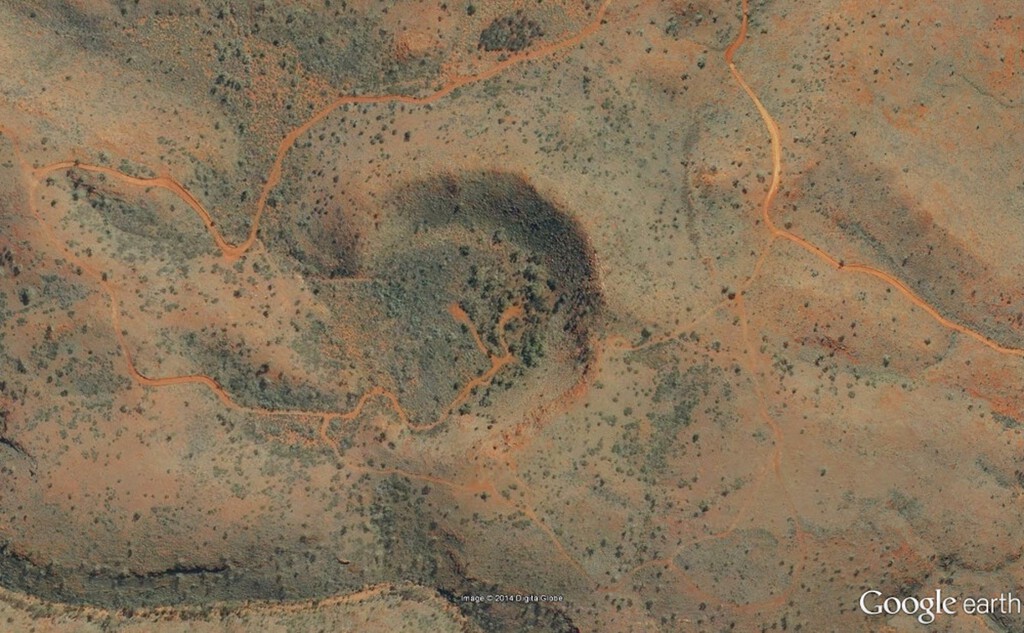
An Australian geologist discovers a perfect circle on Google Earth, potentially linked to a meteorite impact. This finding could unveil information about ancient events on Earth.
In 2007, Australian geologist Arthur Hickman was exploring a remote area of Western Australia for iron when he stumbled upon a strange circle on Google Earth. This circle, approximately 260 meters in diameter, was situated in the rugged landscape of the Hamersley Range, near Newman in the Pilbara region. Its almost perfect shape caught Hickman's attention, prompting him to investigate further.
The circle intrigued Hickman not only because of its regularity but also due to its location. While searching for minerals, the geologist realized that this discovery could be linked to something much older and significant. He subsequently reached out to scientist Andrew Glikson from the Australian National University to determine whether this unusual shape might be the result of a meteorite impact on Earth.
## Why it matters This finding is significant as it could provide new insights into the geological history of Earth and the events that have shaped its surface. Identifying meteorite impacts can help scientists better understand the frequency and types of events that have occurred on our planet throughout its history.
## What we know It has been confirmed that the circle is a geological anomaly warranting further investigation. The collaboration between Hickman and Glikson may lead to more detailed analysis, potentially revealing the exact nature of the circle and its origin.
## What remains unclear It has not yet been confirmed whether the circle is indeed the result of a meteorite impact or if it has other geological explanations. Ongoing research will determine the significance of this discovery in the context of the region's geology.
Read at the original source:
Xataka →Related news
 Science
Space Lasers Set for First Energy Transmission Test
Startup Star Catcher is about to conduct an innovative test for energy transmission between spacecraft using lasers. This advancement could mark a milestone in space energy.
 Science
X-energy progresses on its nuclear plant in Tennessee
X-energy has completed the main structure of its nuclear fuel plant in Tennessee, marking a milestone in the industry. This facility could produce 700,000 TRISO fuel pebbles annually.
 Science
The Science Behind Our Choices and Their Impact
From how we eat to the reintroduction of species, science reveals surprising patterns.