Research reveals the history behind a tea label
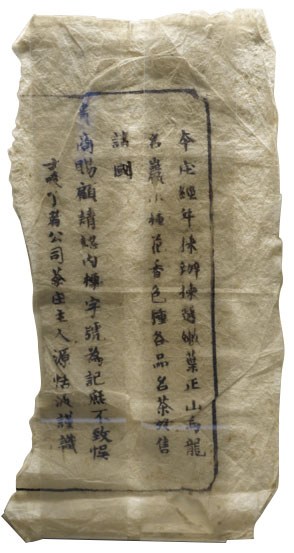
An MIT professor uncovers the origins of a tea label thought to be colonial. His research reveals a more modern and complex context.
A recent study led by Tristan Brown, an associate professor of history at MIT, has called into question the authenticity of a tea label displayed at the Old South Meeting House. This label, donated by descendants of a Boston blacksmith in 1987, was believed to have been recovered after the famous Boston Tea Party protest in 1773. However, after a year of research, Brown concluded that the label was made nearly a century later.
The turning point in the investigation came when Brown decided to read the Chinese text in Cantonese rather than Mandarin, as had been done previously. By doing so, he discovered that the characters were used phonetically and that there were slight variations in contemporary sources pointing to the firm Smith, Archer & Co., a U.S. company that began importing Asian tea for the American market in the 1860s and 1870s.
This finding not only challenges the traditional narrative surrounding the label but also highlights the importance of linguistic perspective in the study of historical objects. Brown's research underscores how a different approach can change our understanding of history and culture, especially in such a significant context as the history of American independence.
## Why it matters This discovery is crucial as it highlights the complexity of colonial history and how narratives can be shaped by misunderstandings. Additionally, it emphasizes the need for critical and multidisciplinary analysis in historical research.
## What we know The tea label, once thought to be an 18th-century artifact, has been dated to the 19th century, specifically linked to the commercial activities of a U.S. company. Brown's research demonstrates the importance of examining sources from different angles to gain a more accurate understanding of history.
## What remains unclear It remains to be seen how this new understanding will affect public perception of the history of tea in America and whether there will be further investigations that reevaluate other historical objects with similar narratives.
Read at the original source:
MIT Technology Review →Related news
 Science
SpaceX to attempt catching Starship and booster next month
SpaceX plans to recover its orbital launch system for the first time. This could mark a significant milestone in space technology.
 Science
Japan launches mission to retrieve samples from Martian moon Phobos
Japan embarks on an ambitious mission to collect samples from Phobos, Mars' largest moon. This project could provide new insights into the formation of the Solar System.
 Science
Google Gemini 4 Argon solves nuclear fusion conjecture
Google's AI has extended mathematical solutions in nuclear fusion, challenging a 59-year-old conjecture.